
Mark Tegtmeier
I had the privilege of speaking on the intersection of UX and localization at World IA Day 2019 in Atlanta, the 2nd-largest site for the global event.
I was a Spanish major and French minor. I was once a freelance translator and I currently use software in English, Spanish, and Italian on a daily basis. Combine that with my love of travel and interacting with people around the world, and localization is a big deal to me.
Localization done right is key to a good user experience for speakers of other languages and users in distinct markets, and unfortunately it's often overlooked or undercooked. Here are a few examples:
Text expansion and wrapping
If we as designers don't consider text expansion when translating from a language that requires less characters, like English, to a language like Italian that typically requires more characters to convey the same thought, our designs can easily break. Consider this example from GroupMe's iPhone app:

Going? is translated into a much longer word, causing some confusing text wrapping.
In this example, "Going?" has been translated "Parteciperai?" Italian has predictably caused text expansion from the English text, and because of the placement to the side of the buttons, the word "Parteciperai" awkwardly wraps to a second line.
A more accommodating layout for text expansion would be achieved by simply placing the question above the buttons, like so:

This stacked layout can adapt more easily for text expansion.
Speak the language of the consumer
This concept could be applied broadly to simply making localized versions of products available to customers with first languages that aren't currently served. More specifically when it comes to data, as in the contexts of messaging and invitations, these should be in the message of the recipient.
I use Trello a lot for collaboration. I prefer it in Italian as I'm learning the language, but when I send an invitation to a collaborator who only speaks English, Trello automatically populates the email content in Italian.
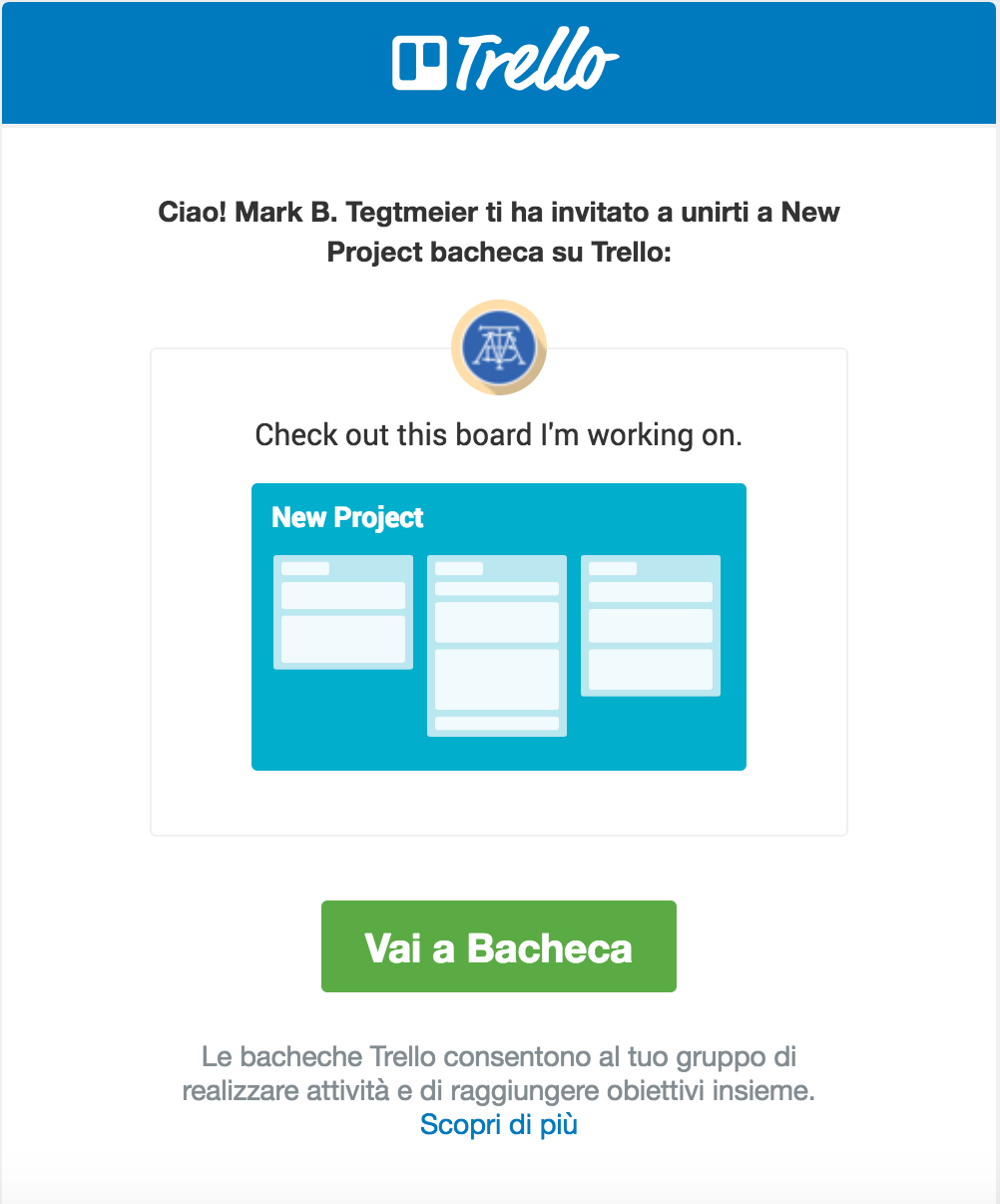
I dare you. Click on this nice green button in an email that's in a language you don't know!
An email in an unfamiliar language can confuse users, or worse, arouse suspicions about the security of interacting with the email. It can even trigger spam filters. None of these are a great experience for either user.
To solve this problem, there are a couple paths Trello could take:
1. If the recipient of the invitation is already a Trello user, check the recipient's language setting to send the email in the recipient's preferred language.
2. If the recipient is not a Trello user, give the sender the choice to send the invitation in a different language.
Mistranslations and missing translations
Mistranslations can become a big issue for localized software, particularly if machine translation is unchecked, context is not provided to linguists, or copy is not written in a way that considers translation.
For example, without proper context or clarity in copywriting, the English word "left" could be translated into Spanish a number of different ways, including, as a small sample, "izquierda" (directional left or the liberal side of politics), "se fue" (somebody departed from a place), or "restantes" (as in items remaining).
Missing translations, or omissions, can also be a problem, especially in the case of text that is not immediately visual such as error messaging and alerts. Again from GroupMe, here's an example of a button that emerges from a prompt that was not translated for the Italian version:

Oops! It's asking me if I'd like to open directions in my iOS Maps app. The first option is Cancel. The primary button wasn't translated though.
QA and proofing is important for localization. I believe we should take it a step further whenever possible though. In the same way that we do usability testing for our verbiage and information architecture in English, we should test to make sure that verbiage, icons, and IA lend to usable and delightful localized products.